Friday, December 23, 2011

Post titleStop illegal loggers and charcoal-makers


By: 


 4share46 33
Pictures don’t lie. Pictures of the flood-devastated areas in Cagayan de Oro and Iligan show many cut logs scattered on the wasteland. The logs were washed down the mountain by the torrents of water. Most likely, they crashed into the houses, causing the houses to collapse and get carried away by the floodwaters.
That can only mean that illegal logging was going on in the forests because legal logging has been phased out.
And this is what is happening to our forests everywhere. First, the logging concessionaires come in, build roads through the forests and start cutting the trees. After they leave, the illegal loggers come in, cutting the immature trees left standing. They leave the logs where they were cut to dry, then come back later to saw them into lumber. That is to escape detection. Up there in the forests, they cannot be seen cutting up the logs. Such were the logs washed down by the raging torrents, the logs that destroyed the houses.
After the illegal loggers come the charcoal-makers who cut even the saplings and burn them into charcoal. Thus, no tree roots are left to hold the soil together. When it rains, the cascading water carries the soil down the mountainsides. With each rain, more and more soil is carried away until only bare rock is left. Thus, the water rushes down more violently.
Meanwhile, the mud carried down by the water is deposited at the bottom of the waterways which become shallower and made to hold less water. Thus, the rivers overflow their banks faster and flood the surrounding areas.
Unless illegal logging and charcoal-making are stopped completely, there will be more and worse floods and landslides. The trouble, where will the construction industry get its lumber? There is a big demand for lumber and the illegal loggers supply some of it.
First, the construction industry must learn to use less wood and more recyclable steel. Philippine construction is very wasteful of wood, a throwback to the time when we still had plenty of wood in the forests.
Form lumber, or the scaffolding used in the construction of residential homes, is wasted after use. They are simply cut into firewood after the house is finished. Some contractors are already using reusable steel scaffoldings but the smaller ones still waste a lot of wood. Coco lumber from coconut trees are filling in some of the demand.
But at the rate we are cutting down coconut trees, all those coconut plantations would soon be gone, just like our forests. So builders should learn to use less wood.
Second, we should be allowed to import wood for the finishing touches like flooring, walls, doors, cabinet paneling and furniture. But that means the forests of wood-exporting countries would be depleted and that would hasten global warming and climate change.
The furniture and woodcraft industries are already running out of wood. Very soon, our furniture-making industry would become extinct—just like the rattan furniture industry after our forests ran out of rattan—unless we import wood. But that would only be transferring the problem to another country, a problem, by the way, that would later on have repercussions on the whole world.
Worse, our sculpture and woodcraft are also running out of wood. Ask the woodcarvers of Paete, Laguna, and they will tell you that it is also becoming more difficult to procure pieces of wood for use in their craft.
And then where will you get the charcoal to feed the voracious appetite of all the ihaw-ihaw restaurants and sidewalk barbecue stands? The big demand for charcoal is the reason many people in the countryside have turned to charcoal-making.
But we already have the technology to make charcoal out of agricultural wastes. Palay husks, coconut coir, coco shells, hay, cogon and talahib, sawdust, sugarcane stalks, corncobs, twigs and leaves, even grass and weeds can all be compressed and turned into charcoal bricks. A former congressman is already making and selling these charcoal bricks. The trouble is he owns the patent for the technology and machine.
So why does not the Department of Science and Technology buy the patent from him and propagate the making of charcoal? That will give more income to the farmers and other people in the countryside. At the same time, it will continue to supply all the ihaw-ihaw and barbecue stands with charcoal. It is also an export product. Do you know that Singapore imports plenty of charcoal?
Our agriculture is very wasteful. Many agricultural byproducts like palay husks and coconut coir are just thrown away or burned when they can earn more income for the farmers. One prime example is the coconut water from millions of nuts made into copra. This coconut water is just thrown away when it can be turned into vinegar and even wine.
When President Aquino came home from the United States sometime ago, he raved about the fad for coconut water there. Coco water is supposed to be a health drink. A local company is already producing and selling coconut water in plastic packs. It costs more than the ordinary soft drinks but is better tasting and more healthful. P-Noy raved about the billions of dollars we can earn if we export young coconuts or buko juice to the United States.
The trouble is when you pick the young buko for export, there would be no mature coconuts left to be made into copra. But the coconut water in the buko is the same as the water in the mature coconuts which we just throw away when making copra. Why not sell this coco water instead and make the coco farmers earn more?

When in Cebu City, please visit also gregmelep.com for your retirement and real estate needs.

Thursday, November 17, 2011

Island declared as turtle sanctuary


For the protection of turtles and other endangered sea creatures
By NONOY E. LACSON

BANGUINGUI, Sulu, Philippines – The municipal government here has declared the Sipak Island off the village of South Paarul as a protected area for marine turtles and other endangered sea creatures living on the island, at the same time has limited the gathering of turtle eggs for commercial purposes.
Mayor Abdulwahid Sahidulla said he has issued an Executive Order (EO) banning the gathering of turtles and turtle eggs at the Sipak Island for commercial purposes.
Sahidulla said the turtles are now seriously considered as endangered species along with several sea creatures by the Department of Environment and Natural Resources (DENR).
Sahidulla personally visited the island on Tuesday together with some officials of the DENR stationed in the Autonomous Region in Muslim Mindanao (ARMM), and was convinced that the entire island should be placed under a government watch here.
During the same visit, Sahidulla with the DENR officials held a forum on the island and informed the people that the local government unit (LGU) here is now banning the gathering of turtle and their eggs for commercial purposes.
“This is one of the few sites that we have in the country today where you can find turtles of various species laying their eggs in the sand, and living along the coastal waters of this island,” Sahidulla said during his recent visit on the island.
Hadja Dar, a resident of the island, claimed that some turtles, including Green Turtles, are having some Chinese markings on their back, an indication she said that the turtles had reached that country.
Turtle eggs are abundant at a local market here and in the markets of neighboring islands, and in this municipality, and is being sold at a price of between P5 to P8 per egg.
The town chief executive here said that he will closely monitor the activities of the people of the island, and will penalize those who will violate the executive order that also carries also a corresponding penalty.
“We have to monitor the people living on this island, and punish those who will violate the order, in order for us to fully protect the turtles and other endangered sea creatures,” Sahidulla emphasized

When in Cebu City, please visit also gregmelep.com for your retirement and real estate needs.
.

Monday, October 10, 2011


Tondo girl’s painting best of 4 million entries

By 


 22share357 327
The girl from Gagalangin in Tondo, Manila, counted Leonardo da Vinci among her idols. At first, however, the shy 13-year-old spoke so softly as Mona Lisa probably would, that you had to lean closer just to hear her.
But one look at her artwork and you’ll see how Trisha Reyes’ eloquence flows through her hands, her strokes on the canvas confident and emphatic like exclamation points, her colors a spectrum of emotions from fear to hope, from sadness to joy.
Combining these skills with inspiration drawn from a recent family outing, Reyes has sent out an urgent message—and the world is taking notice.
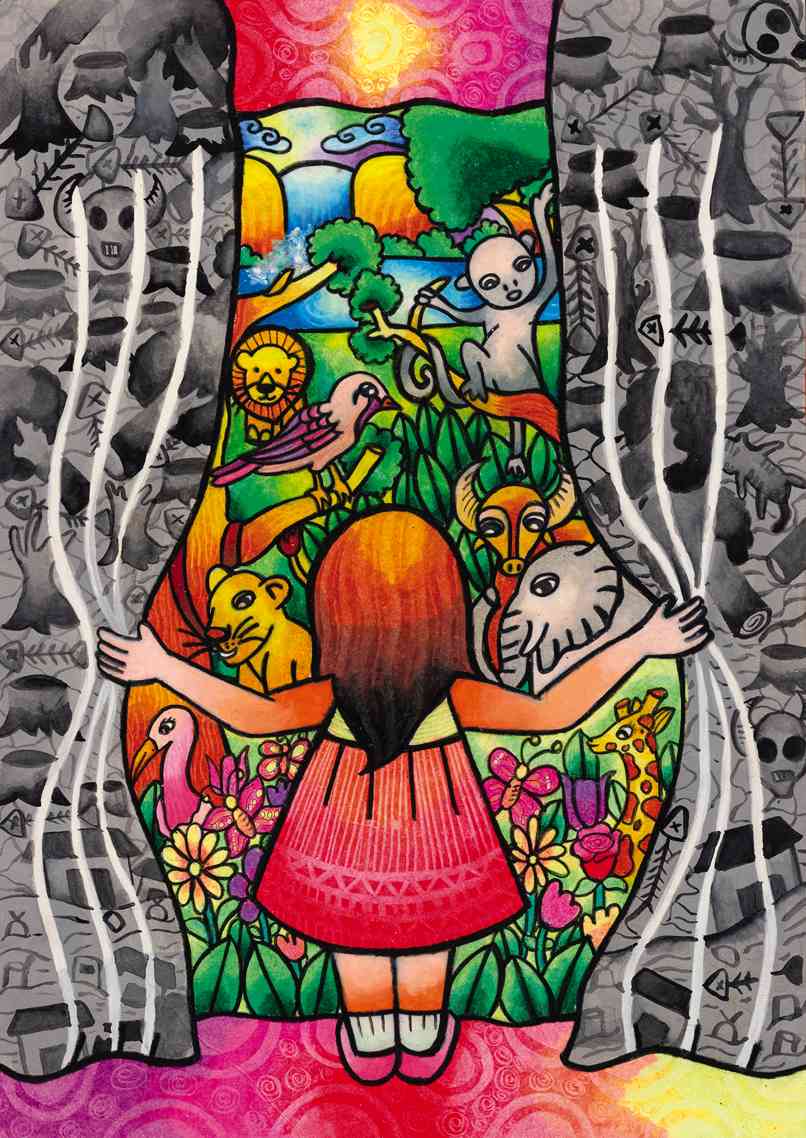
Her “Life in the Forest” topped the 20th United Nations Environment Programme’s (Unep) global painting competition. According to Bayer, a corporate sponsor of the contest, her entry bested some 4 million other children’s paintings from 99 countries.
The freshman from St. Stephen’s High School in Manila received the award and a $2,000 cash prize at the Tunza International Children and Youth Conference held in Bandung, Indonesia, earlier this month.
Her winning work, a 15” x 20” piece rendered in oil pastel and water color, will go on exhibit around the world and will be replicated in Unep posters and calendars, Reyes said in an interview last week.
“I’m very happy but at the same time I didn’t expect (to win).  Of all the entries, I was lucky to be chosen,” she told the Philippine Daily Inquirer.
“There is a lot of news (about the environment) that get mixed up in my mind and adds to my knowledge. I’m very happy because through my painting, I am able to really express my feelings,” she said.
Ugly consequences
And when asked to describe her work, a more confident Reyes spoke almost without pause:
“In my painting, the little girl is me, parting a grey curtain to expose two sides: a sustainable forest and (the consequences of its) destruction.”
On one side, she said, “there is massive deforestation and its ugly consequences like air and water pollution, soil erosion, loss of biodiversity and people’s livelihood.”
On another part of painting, “I envisioned a sustainable forest where plants and flowers grow beautifully, diverse animals, birds, insects roam freely. I would like to express through painting that we must treasure our world’s biological treasures.”
Reyes’ win brought pride to her school. “We’re very happy and very proud of her.  Our school’s philosophy is whatever the students’ interest is, we will help them develop,” said St. Stephen’s principal Judy Tan.
Under the guidance of a trainer, Reyes finished the painting in one weekend in April, three months after  learning about the Unep competition.
A spark from ecopark
She said she drew inspiration from her family’s summertime trip to La Mesa Ecopark in Quezon City, one of the few remaining patches of green in the metropolis.
Reyes’ father Joselito has been a factory worker in Taiwan while her mother Conchita does office work. No one in the family has been into visual arts until Trisha and elder sister Joselle showed their talents.
Reyes said she first developed a love for drawing when she started emulating her sister, now a college senior, who has a knack for animé cartoons. “She was like a mentor,” she said.
At  7, Reyes won her first art competition, an on-the-spot contest at Museo Pambata in Manila.  In the same contest, her sister earned an honorable mention.
Since then, Reyes has racked up one award after another, thanks to what she considers “a God-given gift.”
A catalogue of her works shows her personal trademark of bright colors, unexpected patterns and meticulous attention to detail. In Trisha’s world, skies, flowers and birds are best painted violet or pink.
Asean prize
Her art portfolio has grown into a thick collection of certificates from local and international competitions. In 2009, for example, she flew to Bangkok, Thailand, to collect her prize as the Philippine winner in the Asean Regional Drawing Competition.
At the Unep competition this year, Reyes said she had a blast interacting with fellow young artists from around the world, gaining “new best friends” from Kenya, Germany and Japan.
“We shared stories about our different cultures, our experiences and our hobbies.  The best part was meeting new friends because it adds something to you as a person,” Reyes said.
With “college still a long time away,” Reyes has yet to decide whether she will pursue a career in the visual arts. Right now, she said, she would just focus on her academics while honing her painting skills on the side.
“On Saturdays and Sundays, if ever there’s a contest, I paint in the morning and study in the afternoon, or vice versa,” Reyes said, as though summing up a typical Da Vinci day.