Tuesday, November 6, 2012

US to help PH bring fish back


By 


Fisherman carries large size of Tuna Fish as they transfer from Tuna Port to Public Market in General Santos City. ANDREW TADALAN/ FILE PHOTO
MANILA, Philippines—The government hopes to replenish fish populations in key marine areas around the country through a program called “Ecofish,” a joint project with the United States Agency for International Development (USAID).
Short for Ecosystems Improved for Sustainable Fisheries, the Ecofish project was launched on Wednesday by the Department of Agriculture, Bureau of Fisheries and Aquatic Resources (BFAR) and USAID to improve the management of Philippine coastal and marine resources.
The objective is to make the fisheries sector sustainable through the effective management of eight important biodiversity areas. These areas are the Calamianes Group of Islands in Palawan, Lingayen Gulf in Pangasinan, Ticao Pass-Lagonoy Gulf-San Bernardino Strait in Bicol and Samar, Danajon Double Barrier Reef in Bohol and Leyte, southern Negros Occidental, Surigao, Sulu archipelago, and the Verde Island Passage between Batangas and Mindoro.
Agriculture Secretary Proceso Alcala said Ecofish was designed to contribute to priority goals laid out in the Philippine Development Plan, particularly the conservation and rehabilitation of natural resources.
At the launch of the five-year Ecofish project, Alcala, who was joined by BFAR Director Asis Perez and USAID’s Environment Chief Rolf Anderson, said the government was paying more attention now to the fisheries sector.
He noted that the 2013 budget for fisheries was raised to P4.6 billion to enable the BFAR to rebound and improve its performance, following stagnant production in past years.
Alcala said part of the fund will be used to align methods and systems necessary to “bring the sector back into shape.”
As part of efforts to replenish fish populations, Alcala earlier announced a closed season for harvesting sardines, herring and mackerel in the Visayas Sea from Nov. 15, 2012 to Feb. 15, 2013.
“When there are more sardines in the ocean, tuna species tend to stay longer in our territorial seas, which eventually result in bigger harvest,” he explained.


When in Cebu City, please visit http://gregmelep.com for your real estate and retirement needs. 
Avail of the opportunity to own a condominium unit in Cebu City for only P12,000.00/month with
your own parking lot. Hurry while the supply of units last. Just call the Tel. Nos. shown below.
Tel. No. (053)555-8464/09164422611/09173373687.

Tuesday, October 9, 2012

Reforestation, garbage reduction

Philippine Daily Inquirer

BAGUIO CITY, Philippines—President Gloria Macapagal-Arroyo on Friday endorsed a climate change mitigation plan that requires drastic cuts on garbage generation in cities and provinces to reduce carbon emissions.

The plan calls for massive reforestation, the closure of open dumps, and support for the campaign to reduce garbage generated by households and business establishments.

Arroyo met Environment Secretary Lito Atienza and Heherson Alvarez, presidential adviser on global warming and climate change, here at the end of a Luzon tour that began with a mass in Lubao, Pampanga, and a trip to Cagayan, where she addressed the economic potentials of the Cagayan River.

The government, Alvarez said, had focused on reforestation to curb the Philippines’ carbon emissions because trees absorb carbon dioxide.

But recent studies exposed the government to the contribution of open garbage dumps on the weather, Atienza said.

Methane released by garbage dumps is “21 times more lethal” than emissions from vehicles.

Alvarez said other countries are willing to grant the Philippines financial aid in exchange for cutting carbon emissions by preserving forests, planting trees, and reducing garbage generation.

Methane, like carbon dioxide, also accounts for abnormal weather patterns attributed to climate change, said Atienza, who briefed the chief executive and the city’s village officials at the presidential Mansion here.

Atienza told the village officials that correcting the city’s solid waste management program is tied closely to the government’s commitment to cut carbon emissions.

Baguio has been burdened by a garbage crisis since 2008 and has been spending millions of pesos in hauling trash to a commercial landfill in Tarlac.

Like Baguio, the rest of the country has barely complied with the ecological solid waste management law, and still generates 30,000 tons of garbage daily, representing 678 tons of methane introduced daily to the atmosphere, Atienza said.

Provinces and towns still operate 900 open or controlled landfills, when the law requires local governments to develop ecological sanitary landfills. This meant that only 2.8 percent of local governments have complied with the law, he said.

Arroyo allocated P2.8 billion to help finance the solid waste management projects of all local governments.

She said MalacaƱang would shoulder 20 to 40 percent of the waste management projects of local governments.

“Consider this a centennial gift for a centennial city,” she told Mayor Reinaldo Bautista Jr.

But reforestation remains the primary solution to climate change in the Philippines, said Alvarez.

Mario Mendoza, national director of forest management service of the Department of Environment and Natural Resources, said the country needs to replenish 6.2 million hectares of forest cover.

Mendoza said the DENR is also pursuing a funding scheme to sustain the government’s reforestation program, including a climate change mitigation fee and a user’s tax for pollution generated by extractive industries.

In Cagayan, Arroyo urged local officials to tap the Cagayan River basin, which could serve as a fishery and agribusiness center.

She said Cagayan has been touted as the hottest place in the country, yet its river basin remains very fertile and is best suited for various livelihood activities.

“It is said that Cagayan is the hottest province in the country. This is because it is [located] between two mountain ranges that drive away the cooler air,” she said.

She also led the launching of a coconut plantation project in Lallo town in Cagayan Valley. The project aims to generate funds to plant coconut saplings as livelihood support for Cagayan farmers.

When in Cebu City, please visit gregmelep.com for your real estate and retirement needs.

Friday, October 5, 2012

Quezon government stops wood charcoal making


LUCENA CITY, Philippines—Charcoal production from wood products is now banned in Quezon province, a provincial official said Friday.
“Wood charcoal making in Quezon is now prohibited. The only charcoal material to be allowed is coconut shell which abounds in the province,” Board Member Victor Reyes told the Inquirer in an interview Friday.
He said the Sangguniang Panglalawigan adopted the wood-charcoal- ban provision of the provincial environment code in a hearing conducted by the committee on environment and natural resources.
Reyes noted that wood charcoal particularly from mangroves have been the preferred fuel of the thriving lechon business in Metro Manila and in other parts of the country.
The board member said the high demand have caused the fast depletion of young forest trees and mangroves in Quezon coastal areas.
Board Member Rachel Ubana, chairperson of the provincial council committee on environment, said wood charcoal traders will also face government sanctions if found transacting business in the province.
“We also have to deal with them to stop the business trade that caused the destruction of the remaining trees in the province,” Ubana said.
Fr. Pete Montallana, chair of Save Sierra Madre Network, welcomed the prohibition against wood charcoal making in the province.
“That is a welcome development. I congratulate the members of the provincial council for adopting such a decisive stand against environmental destruction,” the Franciscan priest said over the phone.
He described wood charcoal making in the Sierra Madre as the “last nail in the coffin of Mother Earth”.
“Charcoal makers were more than par with illegal loggers because they cuts young trees for their raw materials,” Montallana said as he noted that sacks of wood charcoals for sale continue to lined up along the highways of Real, Infanta and General Nakar towns at the foot of Sierra Madre in northern part of the province.
He urged the provincial officials to continue their struggle against environmental destroyers.
On Wednesday, provincial officials and environmentalist group Tanggol Kalikasan found stacks of illegally cut fully grown mangroves in a one hectare coastal area in Barangay Salinas here.
The mangroves were sewn either as lumber or for charcoal production.
Manny Calayag, Quezon-Environment and Natural Resources Office (Quezon-Enro) community coordinator, said Governor David Suarez has ordered him to coordinate with the city government in the rehabilitation of the destructed mangrove area.
Calayag said his office still maintain leftovers of mangrove propagules that were used last June where the provincial government led the massive planting of more than two million young mangroves in a single day in different coastal villages of the province.
He said will immediately dispatch a team to assess and make the necessary preparation for the planting of mangrove propagules.
Calayag said as soon as the news of the mangrove destruction was reported in the local media, his office were being swamped with calls from different groups who were offering to help in the mangrove planting project in Salinas.
“We will also conduct education and information dissemination among the villagers on the importance of mangroves to their daily lives,” Calayag said.
Last June 30, the provincial government led the massive planting of more than two million mangrove propagules in a single day in different coastal villages of the province.
Cutting mangrove trees is banned by Presidential Decree No. 705 or the Forestry Code of the Philippines and Republic Act No. 8550, otherwise known as the Philippine Fisheries Code.
When in Cebu City, please visit also gregmelep.com for your retirement and real estate needs.

Saturday, April 21, 2012

Where Mary watches over as nature feeds the soul


By 


share16 12

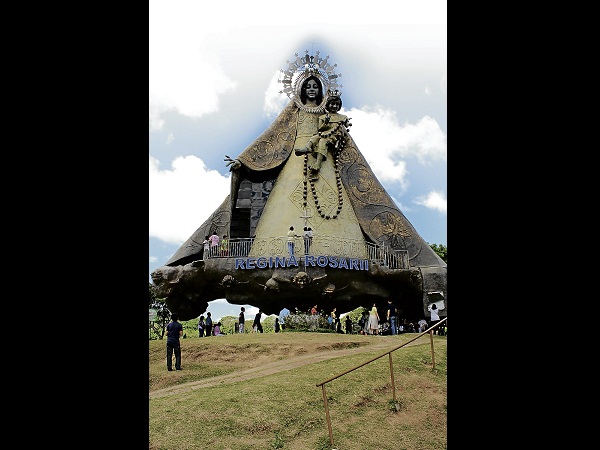
A 71-FOOT HIGH MADONNA AND CHILD image offers solace to the faithful and stands guard against follies that may hurt the environment. PHOTO BY PAOLO V. PAPA/CONTRIBUTOR
On the foothills of the longest mountain range in the Philippines, the Sierra Madre, is nestled a 13.5-hectare ecological sanctuary for spiritual worship and nurturing as envisioned by the Dominican sisters of the Regina Rosarii (Queen of the Rosary in Latin)—the Regina Rosarii Institute for Contemplation in Asia, or Regina Rica.
It is impossible to miss the site. The sanctuary is located on  Sitio Aguho Street in Barangay Sampaloc, Tanay, Rizal province, right after Camp Capinpin and the sprawling estate of former President Joseph Estrada.
A 71-foot high statue of Mary, Queen of the Rosary, carrying the infant Christ, beckons to one and all, guarding some 10,000 mahogany trees and several other kinds of trees and plant varieties, organic gardens and a collection of birds, monkeys, ducks, chicken, geese, hamsters, rabbits, carabaos and horses.
Visitors who stream in daily gladly abide by the reverent discipline of the dress code and subdued conversation as they immerse themselves in prayer under the protective mantle of Mary’s statue, or as they go through the labyrinths of the forest and as they partake of vegetarian food from the organic gardens. They also follow to the letter instructions for waste segregation, using the labeled bins for biodegradeable and nonbiodegradeable wastes.
Several signs announce that the area is a free-plastic zone. The sisters and staff are a wonderful example of volunteers or environmental warriors guarding this environmental haven. What highlights one’s visit is respect for the sanctuary, a deeper realization of one’s self and being and an appreciation of God’s grandeur, in the vision of the English poet and Jesuit priest Gerard Manley Hopkins.
No plastics, please
There is no entrance fee to Regina Rica.  Picnic areas are available for those who choose to bring their own food, but no plastics please. For those who prefer to leave their picnic hampers behind, a canteen  offers vegetarian food.
The sanctuary is open from  8 a.m. to 5 p.m. daily except Tuesdays, with a recitation of the rosary  from 4 p.m. to 6 p.m. There is a Mass every Sunday at 11 a.m., and every fourth Saturday of  the month at 6 a.m. For early risers, there is a dawn rosary at 5 a.m. every fourth Saturday of the month.
There is certainly a need for prayers, not only for human but for divine intervention.
Near the site, the once lush forests and plant and wildlife wealth of the city of Antipolo and the towns of  Montalban, San Mateo and Teresa are almost gone, as many of the hills have turned not only brown from denudation but have become like Lego blocks, gradually being chipped off till they are totally quarried to the ground turned parking spaces for passenger jeeps or commercial compounds. Worse, they have become deep and wide holes turned into dump sites.

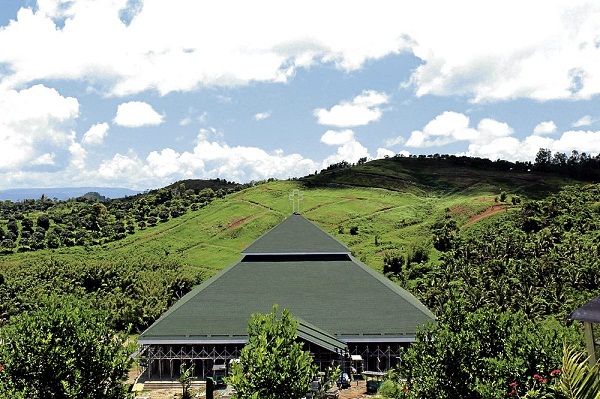
THE CHAPEL, currently under construction, is nestled amid some 10,000 mahogany trees. PHOTO BY PAOLO V. PAPA/CONTRIBUTOR
Rivers, once clear and clean and teeming with fish, have also become toxic with leachate from the garbage dumps and effluents from establishments and homes. Other rivers have been covered by a chaotic sprouting of miscellaneous structures for purposes not really different from high-end development projects with so-called “mixed use” setups.
Not too far away, more commercial interests are fast hacking away at pockets of trees that somehow still help add to the already much depleted supply of oxygen in the metropolis.
Concerned residents of neighboring Quezon City, for example, fear that the establishment of the so-called “central business district” will soon clear the remaining natural shelters of trees in the Parks and Wildlife reserve, the Manila Seedling Bank, the nursery of the Department of Environment and Natural Resources, the trees surrounding Children’s Medical Center and the Lung Center of the Philippines.
Using the Sierra Madre as her podium, Mary must be reminding those who profess to govern this land of their duty as leaders of what is touted as the center of Christianity in Asia: To abide by the faith they profess, carry out the duties and responsibilities they have sworn to do, and uphold the provisions of the 1987 Constitution of this land so blessed, as found in Section 16 under State Policies: “The State shall protect and advance the right of the people to a balanced and healthful ecology in accord with the rhythm and harmony of nature.”
Beyond Holy Week reflections
National and local leaders are advised to go to Regina Rica as part of their reflection even long after the Holy Week is over. We ask them, at least, to help prevent any more of the already threatening intrusions to the site, such as the presence of commercial hog farms and the sale of land rights, including mountain areas that are “titled”  and sold to influential and moneyed individuals and groups, to be used as private resorts or rest houses.
Aren’t these supposed to be protected areas? How did this come about?  There are reports that an influential person will soon put up a local Hollywood in the area. Meanwhile, Daranak Falls is now far from the enchanting hideaway it used to be years back.
Environment Secretary Ramon Paje, in a recent conversation, said the national and local governments should prevent the sale of government lands because as private properties, they  would be easily open for commercial use. “Let the trees in the parks and forests stay. There should be no-build zones in these areas,” he added.
It’s about time government passed the long-pending national land use law. And hopefully, the hills of Tanay—and Regina Rica will continue to live on not only in legend, photographs and in stories of lovers of nature and the environment.

When in Cebu City, please visit also gregmelep.com for your retirement and real estate needs.